AI development
Claude Code + OpenAI Codex
AI-assisted implementation and iteration, guided by hands-on product direction and validation.
Independent product & research studio
Deployed software and applied research for connected homes, property operations, personal health, fitness, and robotics.
Oblique Research · San Marino, California

AI development
AI-assisted implementation and iteration, guided by hands-on product direction and validation.
Connected home
The integration layer connecting devices and automations across the home and property workflows.
Application development
Native SwiftUI interfaces alongside web dashboards, device APIs, and camera streaming.
Spatial computing
Simulation and spatial interfaces connect camera observations with physical layouts and interactive environments.
Application platforms
Home integrations include Lutron RadioRA 3 lighting and Ubiquiti / UniFi cameras and networking. Fitness telemetry and larger robot integrations are development targets, with status shown below.
Property intelligence
A deployed property dashboard that brings reservations, camera observations, and connected devices into one operational view. Used in the daily work of managing a real property.
Reservation-aware views combine camera feeds, motion events, and gate observations, with uncertainty kept visible. Native iPhone, iPad, and Apple TV interfaces support review across devices.


Home automation
An LLM-powered “better Alexa” for the connected home. ClawDomo combines device state, household routines, and conversational context to infer what would be helpful—not just respond to commands.
Home Assistant connects lighting, audio, energy, and security. As new model releases are integrated, ClawDomo makes more helpful inferences from the same household context.

Fitness & connected training
An indoor-cycling companion concept that connects the workout, warm-up, and cool-down. Camera review and planned trainer integrations bring movement and performance into one session record.
The concept covers automatic session capture, form review, workout data, hydration cues, and breaks. Trainer-connected capture and telemetry remain in development.


Personal health intelligence
A private workspace that brings clinical records, biomarker trends, wearable history, imaging reports, and genetic exports into one view. Source-linked observations help organize changes and questions for clinician review, separate from AI-generated interpretation.
Health Atlas reconciles dates, units, and test methods across sources, and labels measured, estimated, and inferred information. It supports personal organization and clinician conversations; it does not provide diagnosis or treatment decisions.

Embodied interfaces
Reggie is the lab’s Reachy Mini and its first deployed embodied AI. Camera feeds, voice, and expressive movement connect SessionLens with the room around it.
Visitor review, robot-camera feeds, and iterative interaction experiments. SessionLens connects what the robot sees with the context of the session.

Physical assistance
Research into physical assistance informed by property and session context: navigating a home, carrying essentials, and handling small hospitality tasks.
Ahead of hardware delivery, development uses available SDKs and simulation. A model of the lab’s backyard provides a shared environment for testing spatial understanding and scripted robot tasks.
Current work SDK experiments and scripted towel and drink delivery in the backyard simulator.
Next milestone Transfer tasks to arriving hardware and evaluate completion, recovery, and human intervention in the lab.

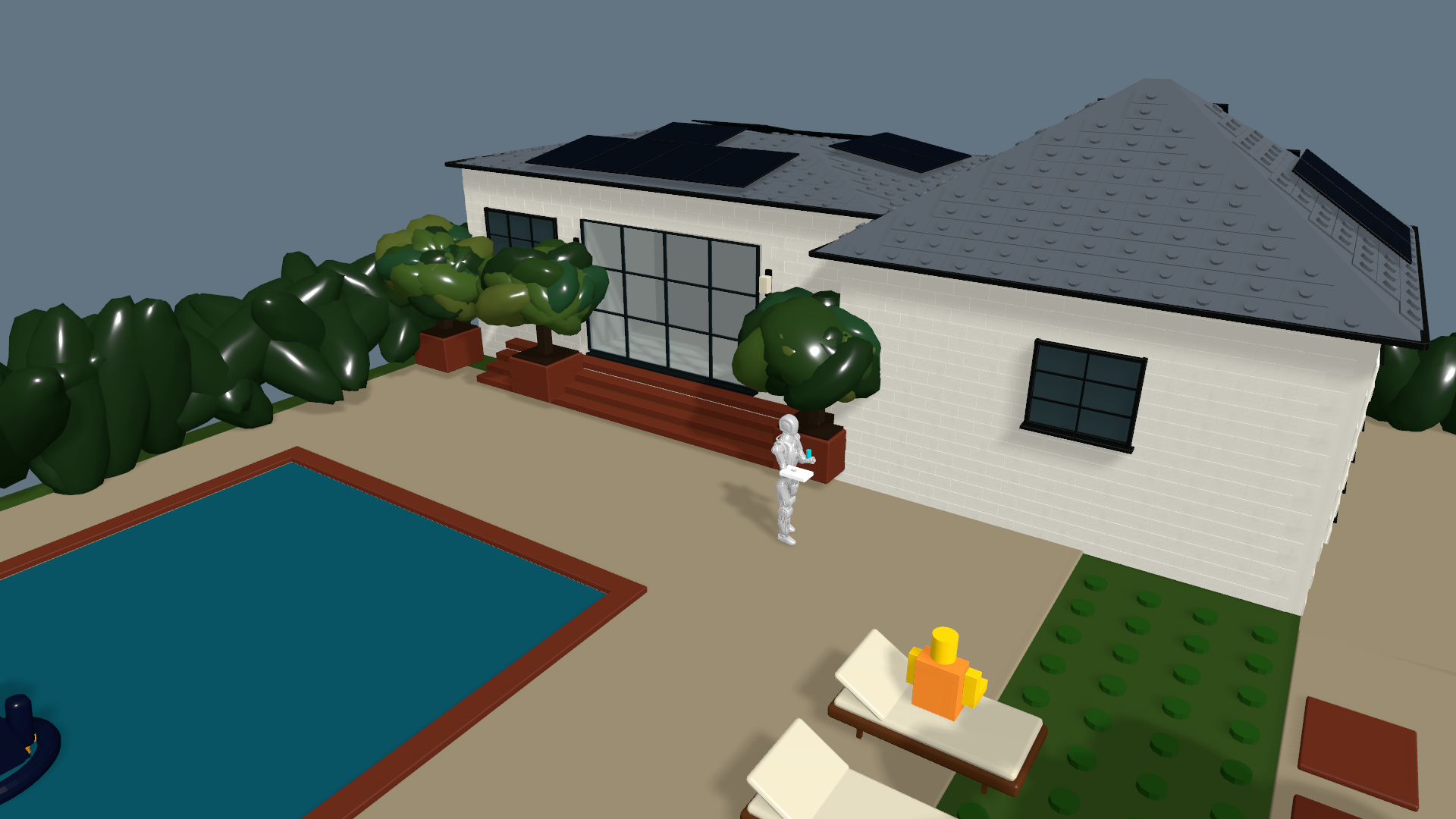
Reggie is deployed today. Hardware on order and under discussion extends the research into mobility, manipulation, and home assistance.
The lab’s first embodied AI: perception and expressive interaction
Meet Reggie ↑
Home humanoid platform
Platform details ↗
Mobile home-assistance platform
Platform details ↗
Humanoid research direction
Platform details ↗
Bimanual service experiments
Platform details ↗The next small robot joining the lab
Status as of September 2026. Preorders and discussions are distinct from deployed integrations. Vendor names identify research platforms; no partnership is implied. 1X logo courtesy of 1X.
Oblique Holdings · future roadmap
Oblique Holdings is the future direction for applying this work to passive real estate: connecting financial visibility with property operations.
Planned workflows cover income and expenses, cash-flow summaries, documents, maintenance coordination, and owner reporting, with AI assistance and human review of financial and operational decisions.
Future roadmap
Integration interest: a Baselane Model Context Protocol (MCP)
connector to bring property finances into AI-assisted workflows.
Discuss an integration ↗
Oblique Research develops and tests applied AI in real environments, from software interfaces to connected devices and physical robots.
Founded by Steven Kaplan, whose background spans Microsoft, LinkedIn, Salesforce, and Audible, the studio combines product experience with hands-on development, integration, and evaluation.
Projects begin with a recurring task in a real setting. Working systems are evaluated through daily use; prototypes and simulation make the next steps testable before wider deployment.
AI-assisted development with Claude Code and OpenAI Codex. Product direction, integration, and validation by Steven Kaplan.